
Getting Started with Digital Dentistry
The scanner is bought or the quote is on the desk, and nobody has shown you the whole workflow. Dr. Hamid Al-Hassiny and Dr. Ahmad Al-Hassiny walk it from choosing the system to bonding the crown, the lectures of their 2021 Wellington live course. Three chapters, ten lessons, 251 minutes, 5.5 CPD/CE hours.

The scanner is in the building, or the quote is on the desk, and nobody has shown you the whole workflow. Which system suits the dentistry you actually do, what to ask the rep before you sign, how to scan so the crown fits, and why the first few CAD/CAM crowns come out flat or chip at the margin.
By the end of this course you should be able to choose the scanner, mill and software for the work you want to do, take a quadrant or full arch scan the software can build on, and prepare a tooth to what a milled ceramic needs. Designing and milling a posterior crown, picking the block for the case, and processing and bonding it the way its material family needs come with it.
Dr. Hamid Al-Hassiny and Dr. Ahmad Al-Hassiny recorded it for iDD. Hamid teaches the first chapter from twenty years of running one of New Zealand’s largest digital practices, the systems he bought, the one he nearly sent back, and the numbers behind the decision, and Ahmad teaches design, milling, preparation, materials and bonding from the same clinic’s chairside workflow.
They recorded these lectures at the live course in Wellington in 2021. All the information and processes are still clinically relevant; just the scanners, mills, software versions and prices are from then.
Three chapters, ten lessons and 251 minutes of lecture, with a ten-question quiz after each chapter and a second one on the materials chapter. Why digital, which system and how to scan fill chapter 01; design, mills and the prep that makes both easy fill chapter 02; and chapter 03 is the four material families, the workflow from sprue to glaze, and bonding.
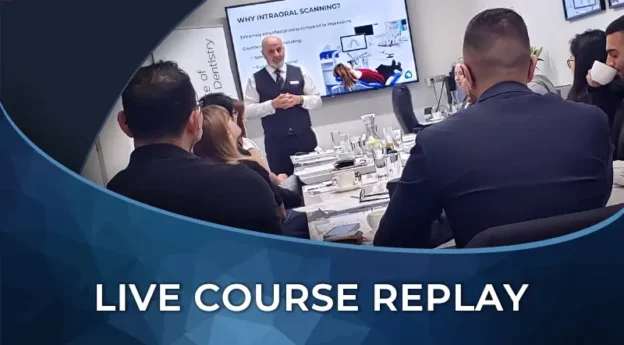
These are the lectures of a hands-on course, so the room is in them. Questions from the floor, the scanners on the bench next door and the hands-on sessions the group is about to walk into are all in the recordings.
What you will learn
- The three things you need to start, and which of them decides whether you do single crowns, full arches or aligners
- What to ask a rep before you sign
- The 2021 scanner tour, Primescan, TRIOS 4, Medit, iTero and the Planmeca Emerald, and what each one is for
- The scanning protocol, a tooth in front, a tooth behind, 10 mm of gum, and a margin you can see, because a margin the scanner cannot see is a crown that will not fit
- The design tools every system shares, and the heat map you check before you mill
- Wet against dry milling, and axes
- High and dry margins, the 1 mm minimum, and why rounded preps stop over-milling
- The four CAD/CAM material groups, which one for which tooth, and the two that stung everyone
- Sprues, crystallization, glaze against polish
- How to bond glass ceramics, hybrids and zirconia, and why the primer matters more than the brand
5.5 CPD/CE hours, assessed by four ten-question quizzes with an 80 percent pass mark and unlimited attempts.
You get lifetime access, updates included.
Written for dentists about to buy or who have just bought a chairside system, for associates in a digital practice who have never been shown the whole workflow, and for the assistants who will scan, mill and glaze once they are trained.
It does not cover the click-by-click of any one system, and it does not go deep on scanning technique or on ceramic processing. For those there are the free Fundamentals of Intraoral Scanning and Modern Prep Design and Margination, then the specialist courses, Ahmad’s Perfect Ceramic Processing and Dr. Tony Mennito’s Bonding – Everything You Need to Know. The full CEREC workflow from administration to milling is Ahmad’s CEREC Clinical Workflows inside CEREC Same-Day Excellence.
Sold as part of CEREC Same-Day Excellence.
Course Content
About Instructor

Course Includes
- 3 Chapters
- 10 Lessons
- 4 Quizzes
- Course Certificate
Ratings and Reviews