All-on-X Scanning Solutions Compared
Why does intraoral scanning fail on full-arch cases when it is the standard of care for single units? This webinar answers that directly. Dr. Ahmad Al-Hassiny, founder of the Institute of Digital Dentistry and a full-time clinician running an in-house digital lab, breaks down the stitching error behind failed All-on-X scans and the technologies that solve it. He compares verification jigs, photogrammetry, and the new horizontal scanbody systems, sharing his own in vitro data on which approach actually delivers a passive fit and how to scan predictably chairside.

Why does intraoral scanning fail on full-arch cases when it is the standard of care for single units? Dr. Ahmad Al-Hassiny, founder of the Institute of Digital Dentistry and a full-time clinician running an in-house digital lab, answers that directly. He breaks down the stitching error behind failed All-on-X scans, walks through the chairside horizontal scanbody workflow, and shares his own in-vitro accuracy data. He then reviews every full-arch scanning solution on the market in 2026, from photogrammetry and scanner-native kits to open scanbody systems and new iPad-based capture.
Full-arch accuracy without the photogrammetry price tag.
Full-arch implant scans fail where single units succeed. See how horizontal scanbodies now match photogrammetry at a fraction of the cost, plus a 2026 review of every system, from scanner-native kits to iPad photogrammetry.
- Understand why full-arch scans accumulate cross-arch error past the 50 to 100 micron threshold for a passive fit, while single-unit scans stay accurate.
- Walk through the chairside horizontal scanbody workflow, from attaching the scanbodies to the digital transfer that lets a capable lab deliver a printed prosthesis in a day.
- See Dr. Al-Hassiny’s own in-vitro data, measured against a contact measure machine, showing horizontal scanbodies hit around 20 to 30 microns, comparable to photogrammetry, and why scanner brand still matters.
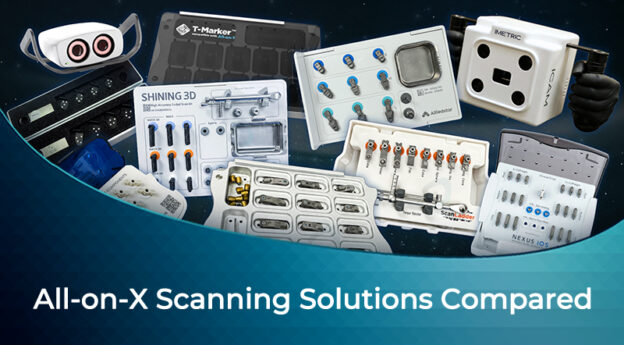
- Compare every major 2026 option side by side: traditional photogrammetry (PIC, iCam 4D), scanner-native kits (SHINING 3D Elite IPG, Alliedstar Direct IP), and open systems (ioConnect, Nexus iOS, Apollo SmartFlag, ScanLadder), along with their cost, software, and sensitivity to technique trade-offs.
- See where the field is heading with iPad and iPhone photogrammetry (TruAbutment’s T-Marker, PIC Dental’s iPhone app) and the Medit Smart-X and 3Shape TRIOS software workflows, which fold full-arch capture into everyday scanners.
- Find out why the iTero Lumina’s large field of view reached sub-60 micron full-arch accuracy with no scanbodies or photogrammetry at all, and what that suggests about whether extra hardware will always be needed.
- Get practical answers on capturing the bite, verifying scanbody seating before you commit, scanning widely spaced and angled implants, and a realistic pathway into full-arch dentistry.
Who is this course for?
General dentists and prosthodontists who place or restore implants and want to predictably move full-arch work onto an intraoral scanner. The course assumes comfort with single-unit and multi-unit implant scanning and is aimed at clinicians ready to take on All-on-X, or those already doing it who want a more accurate, lower-cost workflow than standalone photogrammetry. Anyone weighing up which system to buy in 2026 will find the device-by-device review and accuracy data useful, as will lab technicians supporting digital full-arch cases.
Course Content
About Instructor

Course Includes
- 4 Chapters
- 11 Lessons
- 1 Quiz
- Course Certificate
Ratings and Reviews