

3D Printer Technology Overview
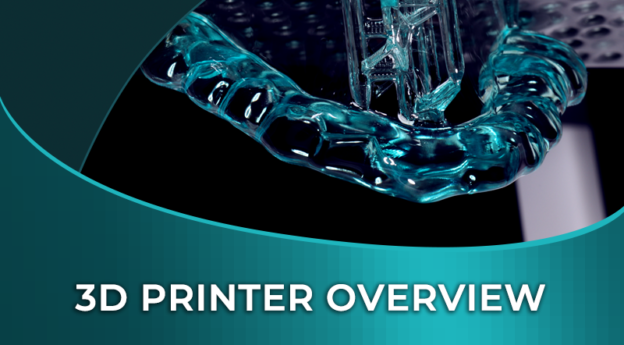
Learn how each main type of 3D printer works, what dentistry prints with it and its limits at the time of recording. Two lectures by Dr. Abdullah Barazanchi, with 1.5 CE hours.

Ask which 3D printer a practice should buy, and every answer starts another comparison. Behind the model names sit a few main ways a printer builds a part. Each one decides what you can print, which materials you can use and how much work is left once the print is done.
By the end of this course you should be able to explain how each main family of 3D printer works and where it fits in dentistry. You will also learn what printing does better than milling, and its limits as they stood when the lecture was recorded, including the ones Dr. Barazanchi says to weigh before you buy a printer.
Dr. Abdullah Barazanchi teaches the course as a two-part lecture, 3D Printing and its Applications in Dentistry. The lecture places printing beside the milling most dentists already know, as a second way to manufacture a design.
Dr. Barazanchi recorded this before mid-2020. All the information and processes are still clinically relevant; just the printers, materials and market figures are from then.
One chapter, two lessons and 52 minutes of lecture, with a ten-question quiz at the end. The first lesson explains the printer families, and the second covers their uses in dentistry, their limits and where the field was heading.
What you will learn
- How 3D printing fits the scan, design and manufacture workflow you may already use for milling
- Where milling falls short: waste, very hard materials, large parts and internal cavities
- Fused deposition modeling, and why it is low cost but not the choice for a highly accurate dental model
- Laser sintering and melting, the powder bed processes behind printed cobalt chrome and titanium
- PolyJet and InkJet printing, which can build with more than one material at once
- SLA, DLP and LCD resin printing, and why curing a whole layer at once is faster than tracing it point by point
- What dentistry prints: models, metal frameworks, burnout patterns, temporary restorations, surgical guides and maxillofacial work
- The limits at the time of recording: printed ceramics and zirconia, supports, the staircase effect, post-processing, machine cost and size, materials tied to one maker, and print time
- Where research was heading, from faster curing to antimicrobial prostheses and bioprinted scaffolds
Completing the course earns 1.5 CE hours from iDD, an AGD PACE approved provider (Provider ID 403044).
You get lifetime access to the course as recorded.
Written for dentists and dental technicians who are new to 3D printing and want to understand the technologies before they choose a printer. No printing experience is needed.
The course explains how the technologies work. It does not teach a printing workflow step by step, compare today’s printer models or cover permanent restorations printed in resin.
For a more recent free introduction, start with Getting Started with Dental 3D Printing. Four courses in the same bundle take the topic further:
- Dental 3D Printing Workflows: Hardware, Software, and Materials, for the hardware, software and materials of a printing workflow
- Fundamentals of 3D Printing in Clinical Practice, for printing in clinical practice
- 3D Printing for Dental Assistants, for running a printer day to day, from the print to the finished appliance
- 3D Printing vs Milling, for choosing between printing and milling
Sold as part of the 3D Printing and Design Bundle.
Course Content
About Instructor

Course Includes
- 1 Chapter
- 2 Lessons
- 1 Quiz
- Course Certificate
Ratings and Reviews

m