Digital Workflows for Implant-Supported Restorations
Most single implant crowns go wrong in the parts, not the design. Dr. August de Oliveira's course covers the scan order, scan body and Ti-base pairing, the materials he trusts on a Ti-base, and whether to mill in house or send the case out, from his own cases.

Most single implant crowns go wrong in the parts, not the design. A scan body and a Ti-base that fit the same hex but will not pair, a bite taken over the scan body, a collar that seats on bone and costs bone, and the cement you find on the recall radiograph.
By the end of this course you should be able to scan an implant site in the order the design software needs, choose a scan body and Ti-base that seat and protect the bone, pick a material for the crown and the temporary, and decide whether to mill in house, send the design to a milling center or hand the case to a lab.
Dr. August de Oliveira recorded it for iDD. Restoring implants has been his work for more than 25 years and placing them for 15, in his own practice on a CEREC and a vhf mill. His own cases are the teaching material, including the ones that went wrong.
He recorded this in September 2022. All the information and processes are still clinically relevant; just the parts, printers and prices are from 2022.
For where implant scanning has gone since, in particular horizontal scan bodies and how they compare with photogrammetry, Dr. Ahmad Al-Hassiny’s All-on-X Scanning Solutions Compared (2026) is the upgrade from this course and is sold separately.
Six lessons and 53 minutes, in one chapter. Expect a practical course, not a materials science lecture.
Lessons one to four are the parts: the scan order, scan bodies and Ti-bases, angled screw channels and the makers he buys from. Materials and money fill the last two, from the block he trusts on a Ti-base to what a milling center, a remote designer and a chairside titanium blank each cost in 2022.
What you will learn
- The three-scan order for an implant site
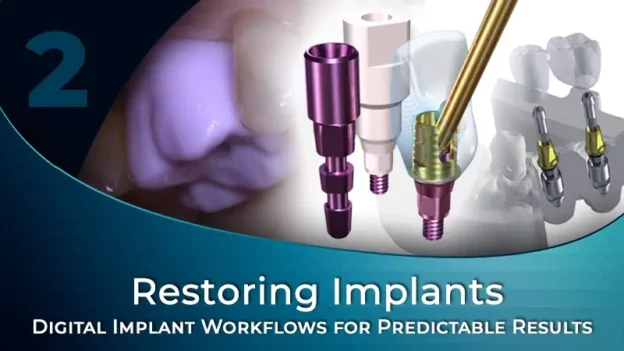
- How scan bodies and Ti-bases pair, what to avoid in a scan body, and which geometry the software reads to orient the implant
- The concave gingival profile, and the gingival height to choose on a subcrestal implant
- Angled screw channels and the screwmentable crown
- His scan body and Ti-base sources (DESS, Elos, 3Shape, Implant Direct, TruAbutment), and what a same-day CEREC crown locks you into
- Which materials he trusts for implant crowns and temporaries, and the one he stopped using for permanents after it flexed off a Ti-base
- Milling center, remote designer or printed analog model, what each cost in 2022 and when each is the better route
1.5 CPD/CE hours, assessed by a ten-question quiz with an 80 percent pass mark and unlimited attempts.
You get lifetime access, updates included.
Written for general dentists with an intraoral scanner who want to restore single implants themselves, with or without a mill.
Hybrids and full-arch cases are not covered; Dr. de Oliveira takes those up in his next lecture, and full-arch scanning itself is the subject of All-on-X Scanning Solutions Compared.
Sold as part of the Digital Implantology Bundle.
Course Content
About Instructor

Course Includes
- 1 Chapter
- 6 Lessons
- 1 Quiz
- Course Certificate
Ratings and Reviews