
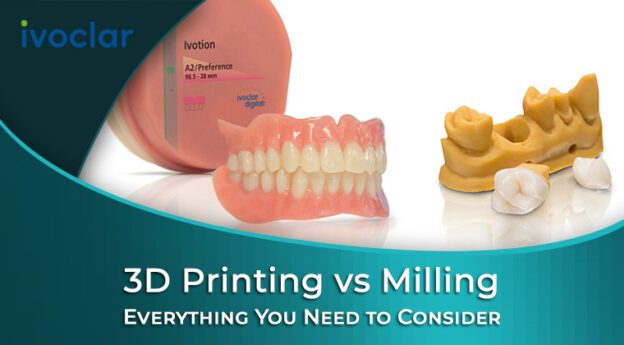
3D Printing vs Milling – Everything You Need to Consider
Print your crowns or mill them? In about 48 minutes of lecture from May 2024, Dr. Ahmad Al-Hassiny weighs printed crowns against milled ones, e.max above all, on strength, esthetics, workflow and equipment cost. He also shows where he uses printed restorations in his own practice. Completing the course earns 1 CE hour.

You have probably heard the pitch. Print your crowns in-house, and if one fractures, just print a new one. Your patient may not see it that way.
If a printer already sits in your practice, you have probably asked why it is not making crowns yet. The harder question is whether a printed crown stands up next to the milled e.max and zirconia you trust.
By the end of this course you should be able to weigh a printed crown against a milled one on strength, esthetics and workflow, and a printer against a mill on cost. You should also be able to say where printed restorations earn a place in a practice, and where milled ceramics keep theirs.
The lecture is by Dr. Ahmad Al-Hassiny, a general dentist in Wellington, New Zealand, who works in a family practice alongside an in-house lab of six technicians. He mills crowns every day and uses printed restorations too, so he sees for himself whether the marketing pitch is true.
He gave this lecture at the Digital Dentistry and Dental Technology Symposium in Sydney in May 2024. All the information and processes are still clinically relevant; just the resins, printers, prices and market figures are from then.
Three chapters, nine lessons and about 48 minutes of lecture, with one ten-question quiz at the end. His audience was a room of dentists and technicians, and their questions are part of the recording.
What you will learn
- What we mill, and why e.max is the benchmark a printed crown has to match
- What a practice printer makes besides crowns, and why he calls it a production facility in your practice
- How printable crown resins changed after January 2023, and what is really in the bottle
- How strong a printable crown resin could get by 2024, and what stops it going further
- The steps between the printer and the mouth
- How a printed crown looks without staining or editing, and the catch with light-cured glaze kits
- Each advantage claimed for printed crowns, weighed by a dentist who mills, and what he says is really behind the hype
- The disadvantages he found, from shade and polish to white lines, and the wear, and staining with some resins, that other dentists reported in 2024
- Where he uses printed restorations in his own practice, with one full-mouth case
- SprintRay’s Midas printer, and Ivoclar’s presence at its launch, as he saw them in 2024
Completing the course earns 1 CE hour from iDD, an AGD PACE approved provider (Provider ID 403044).
You get lifetime access to the course as recorded.
Written for dentists and technicians deciding whether to print or mill single crowns. It also suits anyone who owns a printer and keeps hearing they should print their own crowns.
It is a comparison lecture, with no hands-on printing, milling or design workflow. For the printing workflow, see Fundamentals of 3D Printing in Clinical Practice, and for the printers themselves, 3D Printer Technology Overview. For the wider question of whether 3D printing lives up to its hype, there is 3D Printing – Hype or Not.
For processing milled e.max and zirconia, see his Perfect Ceramic Processing. For milling crowns chairside, see CEREC Same-Day Excellence.
Sold as part of the 3D Printing & Design Bundle.
Course Content
About Instructor

Course Includes
- 3 Chapters
- 9 Lessons
- 1 Quiz
- Course Certificate
Ratings and Reviews





Little bit education usefullnes